LUCAS CANTER – Volunteer Highlight
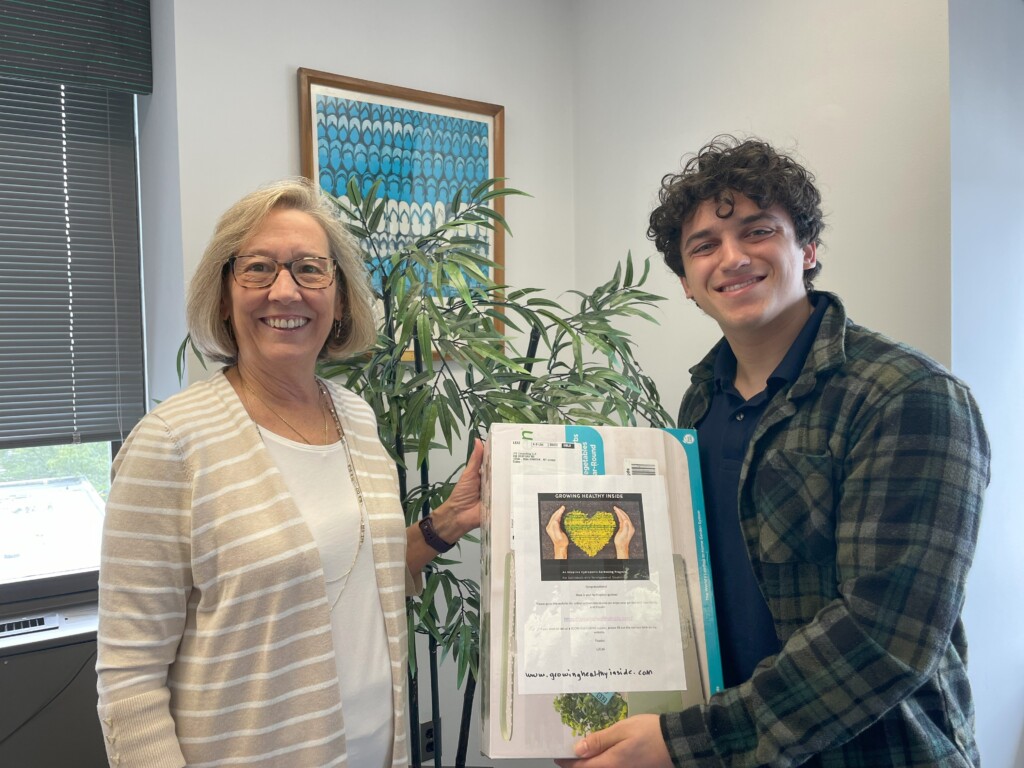
Lucas (right) with Dr. Susan Fox (left), President and CEO of WIHD, upon donation of hydroponic gardening kits to WIHD.
“It means a lot to see the impact that you can have on a person’s life and the emotional impact of a ‘small’ thing like eyeglasses and other assistive technology. [For others], it can be massive.”
– Lucas Canter,
Senior High School Student at Byram Hills High in Armonk, NY
WIHD Volunteer (2022-2023)
Lucas Canter’s Volunteer Story: A passion for Assistive Technology, hydroponics, video games, and helping others
October, 2023
Lucas can effortlessly rattle off data on Assistive Technology access as well as imply the significance of empathic connection to others – all in the same sentence. What started as a deep curiosity in his early teens about the role that Assistive Technology plays in the lives of people with disabilities, has grown into a fully-fledged passion for helping others and the architecture of a purpose-driven career path.
From a young age, Lucas was struck by how few people with disabilities had the Assistive Technology (AT) they needed. AT is defined as anything used to increase, maintain, or improve the functional capabilities of individuals with disabilities. Common examples of AT are white canes, eyeglasses, and walkers, while more sophisticated ones are augmentative and alternative communication (AAC) tablets or laptops, and complex power wheelchairs. Without this technology, people with disabilities may be unable to secure desirable jobs, have meaningful social engagement, or enjoy their environs. The AT Program at WIHD addresses these challenges through our multi-disciplinary team and helps people across their lifespan as well as their families and support teams. Lucas began volunteering part-time with the AT Program in 2022.
Lucas’ interest in working with people with disabilities and, in particular, in visual AT started before his volunteership with WIHD while working as a Youth Leader at Backyard Sports, an adaptive sports camp hosted by Purchase University. He bonded with a child who is blind. The more he tried to understand the issues facing the program’s participants, the more he appreciated the lack of accessibility generally in our society, but especially for the visually impaired and severely physically disabled. He saw the harm this can have on people’s quality of life by limiting social connection, job opportunities, and enjoyment of the physical world.
Early on during the COVID-19 pandemic when students were challenged with a whole new paradigm of remote learning and increased social isolation, a project opened up at WIHD to make adaptive video games. Luis, who has quadriplegia, piloted the project on a gaming system received as a donation to WIHD. Lucas, with his love for AT and also, conveniently, for video games, enthusiastically jumped in.
Few, if not any, video games are built with universal accessibility in mind. Some have voice-overs for the controls, but people with physical disabilities like quadriplegia must use a QuadStick and adapt the game’s controller themselves. This is a complex and time-consuming process. Essentially, the QuadStick is a hands-free controller operated solely using the player’s mouth. It translates the actions on a standard videogame controller to a series of lip position and breath-controlled (e.g., “sips” (inhales) and “puffs” (exhales)) switches. Once Luis was comfortable with the basic use of the program within a single game, Lucas then programmed setups for additional games based on Luis’ input. He built additional individualized setups for Luis’ X-Box that allows him to play a larger variety of games. Luis can now play his favorite games without any assistance and his testimony shows just how empowering working with Lucas has been.
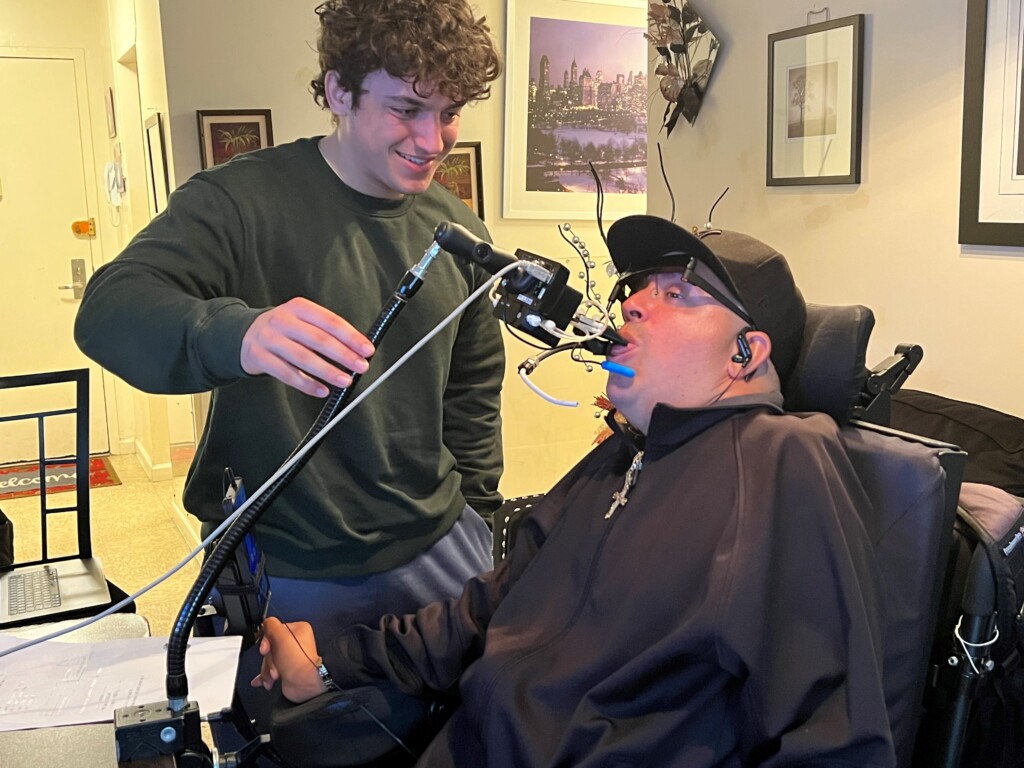
Lucas (left) positions the QuadStick for Luis (right). The QuadStick is an AT Device that enables people with quadriplegia to play video games.
“Being able to play video games using the QuadStick has changed my life. It takes me away from problems and isolation and helps me to have a good time, especially when I can socialize via video games with people around the world. Since I was injured in my neck and have pain, it helps me to get stronger because of the position I put the controller on – putting it up and down and left and right – is like exercise I need for my neck. Having Lucas help me set this up, WOW, it was just amazing and empowering. It has been awesome to have this new technology impact me in my day-to-day life. I am so grateful to WIHD’s occupational therapist Karen Van Den Heuvel for connecting me to Lucas and getting a dream to actually work. This has been very empowering.“
-Luis Ortiz, Client Greeter at WIHD
Designing activities and learning opportunities that foster genuine human connection is important to Lucas. This is evident in his various engagements outside of WIHD and the new initiatives he has introduced here. He founded Growing Healthy Inside to provide resources and tools for people with disabilities to be able to cultivate hydroponic gardens. The purpose is to unite families through gardening and promote healthy eating. Lucas donated his kits and training time to clients at WIHD.
Through Lucas’ academic work and hands-on experience with WIHD and several other organizations, he’s identified that he wants a career in Kinesiology, which is the medical and therapeutic study of the movement of muscles and joints. With this advanced degree, he’d like to find a way to improve AT devices to be more user-friendly and less stigmatizing. Ultimately, he believes it is about empowering people with the proper equipment and care so that they can have a better quality of life, be at the center of their own decision-making, and have more opportunities for work, leisure, and socialization.
Lucas approaches his volunteer engagements with tremendous humility and enthusiasm. He loves the human connection he’s cultivated and the lasting relationships with children and adults of all ages and abilities. Lucas refers to what he has done as a series of ‘small’ contributions, but each ‘small’ thing has compounded over time culminating in a significant impact on the lives of young people and adults with disabilities served by WIHD and everywhere.
If you’d like to find out how to volunteer with WIHD, please contact
Liz Pavlovich, Director of Development and Community Engagement
at epavlovich@wihd.org.